
First network meeting for the Knowledge Foundation’s jubilee doctoral students
For two days at the end of April, Halmstad University hosted the first network meeting for the Knowledge Foundation’s jubilee doctoral students, a major initiative aimed at supporting the next generation of collaborative researchers. The University welcomed 44 doctoral students from 22 universities to focus on the co-production of knowledge and how collaboration with external partners can contribute to impactful research that benefits society.
“A key part of the network meeting was to make visible what value creation actually means within the doctoral students’ projects.”
Jens Nygren, Professor
Between 2025 and 2030, the Knowledge Foundation is funding 44 doctoral students at 22 universities across Sweden. Through joint activities and workshops, the network is designed to bring together doctoral students and supervisors from different fields of knowledge and institutions.
The aim of the meeting was to give the doctoral students an opportunity to share experiences, explore different approaches to co-production and strengthen their professional networks.
“A key part of the network meeting was to make visible what value creation actually means within the doctoral students’ projects. By working concretely to formulate and structure this, they not only gain clearer direction in their research but also a deeper understanding of how value is created through co-production with different stakeholders”, says Jens Nygren, Professor at Halmstad University and one of the organisers of the network meeting.
LEGO brought research projects to life in a hands-on workshop
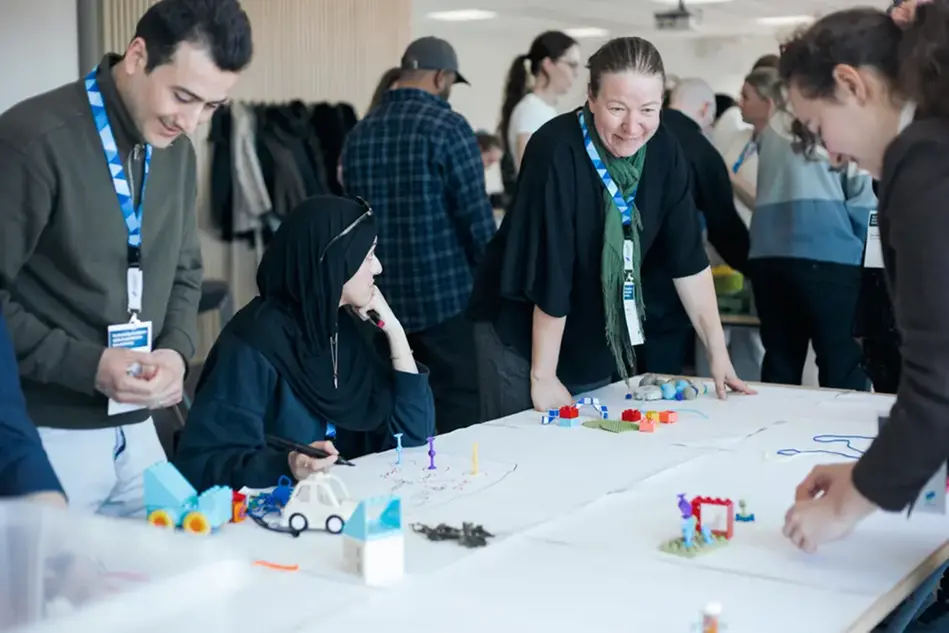
The programme for the first network meeting included an introductory workshop in which the doctoral students used an impact vision approach to make their ambitions for societal impact more tangible. Using LEGO bricks, modelling clay and other creative materials, the participants built shared future societies in which they had successfully realised their research ambitions.
“Creating a shared and creative vision of the kinds of societies these projects could help build not only enables the doctoral students to identify desirable and concrete outcomes for people and nature, but also helps them engage more deeply with and discuss each other’s projects. The group also grew closer by exploring how the different project scenarios connected across sectors and disciplines. That is the strength of working with tangible materials”, says Vaike Fors, Professor at Halmstad University and one of the workshop facilitators.
Greater understanding of both one’s own and others’ research
Two of the doctoral students in the network are based at Halmstad University: Mirjeta Syla, a doctoral student in Health and Lifestyle, and Melania Mihalcea, a doctoral student in Information Technology..
“The past two days have been filled with workshops where we have collaborated in different ways. One activity involved building cities using creative materials, which was both enjoyable and engaging and gave us valuable insights into both other people’s research and our own, viewed from different perspectives. The network meeting has shown how shared exploration and dialogue can help us understand both our own and others’ research within a broader context”, says Mirjeta Syla.
Text: Emma Swahn
Photo: Anna-Frida Agardson
The Knowledge Foundation’s Jubilee Doctoral Students
The Knowledge Foundation helps strengthen Sweden’s competitiveness by funding research and competence development at Swedish university colleges and newer universities in close collaboration with industry.
Between 2025 and 2030, the Knowledge Foundation is funding 44 doctoral students at 22 universities across Sweden. The initiative was launched as part of the Foundation’s 30th anniversary celebrations and aims to strengthen collaboration between academia and the wider society.
