Training programme in transparency and collaborative policy-making
How can transparency and collaboration contribute to more open, accountable and effective policy-making? The training programme Transparency Practices in Open and Digital Collaborative Policy-Making, brings together professionals from across the EU’s Eastern Partnership region to explore this question.
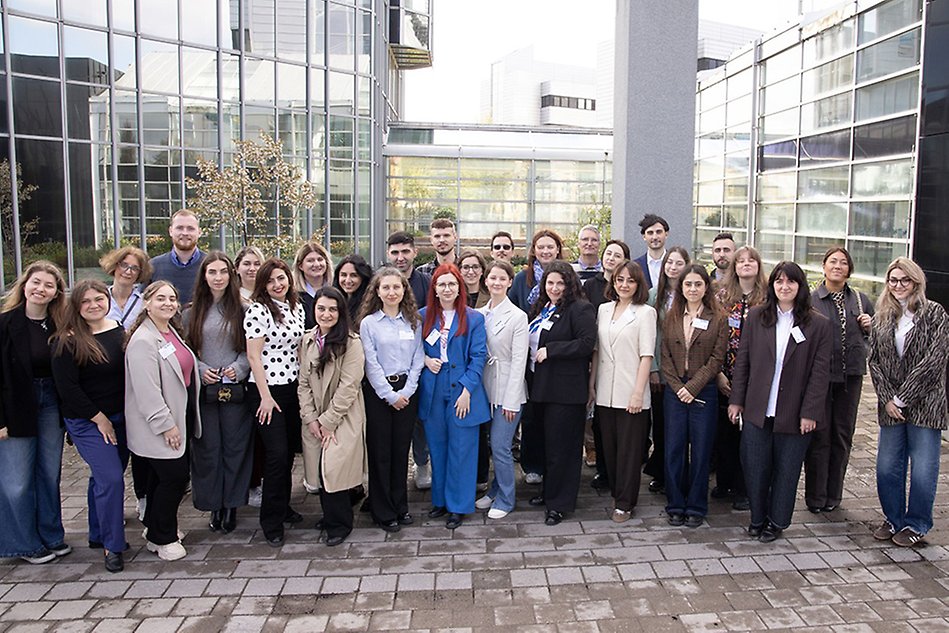
Participants and teachers on campus in Halmstad during the 2026 training programme: Policy Integration and Transparency Practices in a Digital Era. Photo: Dan Bergmark
Through learning, exchange and practical application, the programme provides participants with new perspectives and approaches to transparency and collaborative policy-making, while supporting them in translating these into meaningful change within their own organisations. The programme is funded by the Swedish Institute, and organised by Halmstad University in partnership with the Democracy Development Foundation (DDF) in Armenia.
About the programme
Transparency Practices in Open and Digital Collaborative Policy-Making is designed for professionals working with governance and public policy in the EU’s Eastern Partnership region who have the ambition and potential to contribute to change within their organisations and professional contexts. It focuses on how transparency, access to information and responsible data sharing can support democratic, collaborative and effective policy-making in an increasingly digital environment. Participants will explore how transparency and accountability interact with digital governance, collaborative governance, policy integration and cross-sectoral coordination.
Through a combination of online learning and an on-site training week in Sweden, hosted by Halmstad University, and a regional hybrid module hosted by Democracy Development Foundation in Yerevan, Armenia, participants will explore key topics such as collaborative governance, anti-corruption, and the role of digitalisation in public sector development. The programme includes interactive seminars, study visits, and group-based case work, allowing participants to connect theoretical insights with real-world challenges from their own professional contexts. Participants will also engage with peers from across the region, building networks and exchanging experiences. By the end of the programme, participants will have developed practical tools and strategies to apply in their work, supporting more transparent, accountable, and effective governance practices.
Key highlights
- Interactive learning: engage in stimulating discussions, workshops, and case studies focused on key topics such as collaborative governance policy-making, public leadership styles, digitalisation in public administration, understanding corruption and its impact, and leveraging e-governance for enhanced transparency.
- Exploring digital transformation: delve into the latest trends and technologies shaping digital transformation in public administration. Explore topics such as harnessing technology for public administration, evaluating digital anti-corruption tools and developing digital transparency strategies.
- Fostering collaboration: learn about the importance of cross-sector collaboration and conflict resolution in governance processes. Understand how collaborative governance can bridge bureaucratic, market, and network-based approaches to achieve more effective outcomes.
Benefits of participation
- Professional development: enhance your leadership abilities, gain practical insights into collaborative governance practices, and learn to leverage digital tools for enhanced transparency and accountability.
- Global perspective: gain a deeper understanding of regional and global governance issues, exchange ideas with peers from diverse backgrounds, and explore innovative approaches to address shared challenges.
Change project
Please note that an important part of the programme is the development of a participant-led change project.
Applicants should be prepared to identify a concrete challenge, need or opportunity connected to their organisation or professional context. During the programme, participants will develop and refine their change project through training, peer exchange and feedback from experts and other participants.
The change project is intended to provide an opportunity to apply knowledge and approaches from the programme in practice. Applicants should therefore have sufficient opportunity within their professional role to contribute to the development or implementation of change in their organisation or professional context.
Programme dates and agenda
Dates
- February 2027: Online introductory session
- March–May 2027: Five online training sessions, held on Thursday afternoons, approximately four hours per session
- 7–11 June 2027: On-site training week at Halmstad University, Sweden
- June–August 2027: Applied case-work phase
- September–October 2027: Implementation and reform-strategies
- 17–19 November, 2027 (TBC): Regional on-site module in Armenia with possibility to participate online
- November–December 2027: Final evaluation and follow-up
Agenda
The online components of the programme are delivered in five sessions during spring 2027. Each session is held on a Thursday and lasts approximately four hours, typically scheduled in the afternoon to accommodate participants across time zones. Sessions combine interactive lectures, discussions, case work and opportunities for peer exchange.
The on-site week in Halmstad will include a full-day programme, with a mix of class discussions, expert lectures, workshops and study visits to local and regional institutions in Sweden and Denmark. Participants will also work on the development of their individual projects.
Throughout the programme, participants will engage with a range of guest speakers from academia, public administration and civil society, offering applied insights and real-world examples.
The Armenia on-site module builds on the knowledge and skills acquired during the online sessions and the on-site module in Halmstad, with a focus on regional practices, challenges and best practices in governance and policy transparency. It provides participants with an opportunity to apply their learning through case-based work, peer exchange, and the development and refinement of participant-led change projects.
A key component of the module is dialogue with Armenian and regional stakeholders, including state officials and civil society representatives. Participants will have the opportunity to present and pitch their projects, receive feedback, and explore opportunities for practical implementation. Through joint reflection, networking and policy dialogue, the module strengthens cross-country collaboration and supports participants in translating knowledge into meaningful institutional and policy improvements.
The programme concludes with a final reflection session that connects key learnings and supports future collaboration.
Application and requirements
How to apply?
Applications are open from 1 October to 8 November 2026.
To apply, please complete all the application documents below and submit your complete application by email to sayp_halmstad@hh.se no later than 8 November 2026.
Your application should include the following documents:
- Letter of motivation docx, 47.7 kB.
- CV (EUROPASS) doc, 118 kB.
- English Language Certificate docx, 32.5 kB.
- Letter of reference docx, 99.8 kB.
Please make sure that all required documents are completed and attached before submitting your application. Incomplete applications may not be considered.
Please note that the Swedish Institute funds several training programmes. You may apply to more than one programme, but you can only be admitted to one.
Who can apply?
The programme welcomes professionals working in areas related to transparency, collaborative governance, digitalisation, public administration, anti-corruption and related fields.
You can apply to the programme if you:
- are a citizen of or resident in Armenia, Azerbaijan, Belarus, Georgia*, Moldova or Ukraine;
- have a good command of English, both spoken and written;
- are professionally active and represent a relevant organisation, network or interest in one of the programme countries;
- have a professional profile relevant to the thematic content of the programme; and
- have the mandate, ambition and potential to drive change within your organisation and professional context.
*Applicants from Azerbaijan, Belarus and Georgia cannot represent organisations that are part of, controlled by or financed by the state, such as public authorities, public institutions, or state-owned or state-controlled companies.
Applicants may work within:
- Policymaking, including policymakers, government officials and employees of political organisations;
- Public administration, including non-political civil servants working in public organisations;
- Civil society, including employees of civil society and non-governmental organisations; or
- The private sector, particularly in roles relevant to the thematic focus of the programme.
Costs
Participation in the programme is free of charge for selected participants.
The programme is funded by the Swedish Institute (SI). The programme covers expenses related to the on-site training week in Sweden, including travel, accommodation, meals and local transportation.
