
Master's Programme in Embedded and Intelligent Systems - AI, IoT and Robotics
As a specialist in embedded and intelligent systems, you will have technical expertise, research experience and good career opportunities after graduation. This master’s programme provides both practical and theoretical knowledge of areas such as embedded ArtificiaI Intelligence, Internet of Things, and robotics, in which Halmstad University excels when it comes to international research.
Education occasions
About the education
Innovative environments and teaching methods
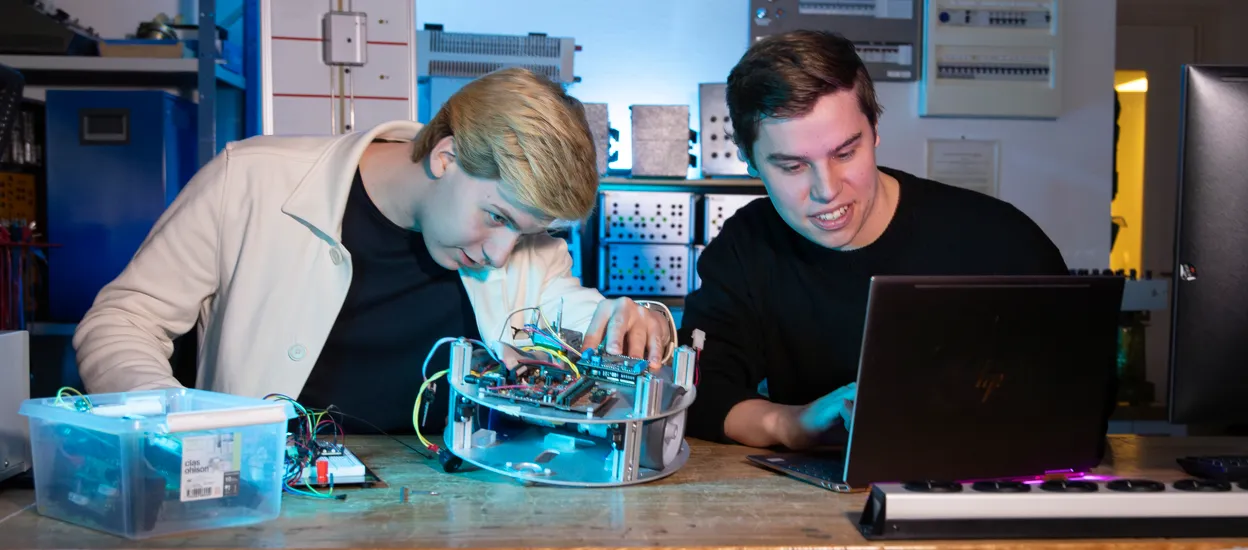
The education at Halmstad University is characterised by our profiling as a university that drives innovation. This programme is strongly linked to the University's focus on smart cities and communities, and internationally-renowned research in AI, IoT, and robotics. The education especially relates to the design and development of software for embedded AI systems, such as autonomous vehicles.
Many of the programme's technical courses are project-based and give you the opportunity to immerse yourself in current international research. Applications for autonomous vehicles feature in several parts of the programme.
Small student groups and frequent group work enable close contact with your classmates and lecturers, helping you to build a professional network for your future career.
Courses and competencies in focus
In the Master's programme in Embedded and Intelligent Systems, you build up theoretical and practical skills for research, design and development of embedded intelligent systems. You can also obtain in-depth knowledge of embedded/embodied AI, deep learning, machine learning, computer vision, signal analysis, sensor systems, IoT, computer communication networks, parallel computing, real-time systems, robotics, autonomous vehicles, and testing. Although you will learn about embedded systems like robots, this programme does not focus on electronics or hardware. Rather, the focus is on computer software, so you will require good programming skills.
In the first semester, you take courses in the programme's main field of study, computer technology, brushing up on some fundamentals of programming, math, artificial intelligence, and communication systems. In the second and third semester, you choose courses which focus on intelligent systems or embedded systems or both. In the third semester, all students take the project course "Design of Embedded and Intelligent Systems". In this course, you will participate in a larger project where you will contribute with the specialised knowledge and skills you have accumulated.
Learn more about the courses included in the programme in the programme syllabus.
The programme is conducted in English.
Specialise with elective courses
From the second semester, you will learn about intelligent vehicles, machine learning, and image analysis. You will also be able to choose more specialised electives in robotics or embedded parallel computing.
Collaboration opportunities
The programme is carried out in collaboration with industry. In the degree project, which is done during the fourth semester, most students collaborate with one of our research groups, often with an industrial connection.
After the education
Degree
The programme leads to a Degree of Master of Science with a major in Computer Science and Engineering.
Career
The Master's programme in Embedded and Intelligent Systems prepares you for advanced development work or research in industry or academia. This can involve developing advanced computer technology applications in areas such as data science and artificial intelligence, IoT, telecommunications, robotics and transport, testing, and embedded software development. Computer technology has an important role in health technology, media, and the entertainment industry as well. Another possible area of work is the design and development of smart products and services based on computer technology that people feel confident about using.
Potential positions after graduation:
- AI Engineer
- Data Analyst/Engineer/Scientist
- Embedded Engineer
- IT Team Leader/Program Manager
- Robotics Software Engineer
- Software Engineer/Developer/Programmer/Consultant
Opportunities for further studies
After completing the programme, you are qualified to apply for doctoral and PhD level studies, for example in the University's third cycle courses.
Instructions for the application
Proof of programming skills to be uploaded
Applicants must prove that they fulfill the entry requirements in programming by submitting syllabi of successfully completed programming courses from their transcripts, including course content and learning objectives connected to the requirements of the programme. The course syllabi must be issued by the university in which the course were given, and should be uploaded at Universityadmissions.se, together with other required documents. There are no formalised templates or standards required for these documents.
Contact
- Questions about entry requirements, selection and admissions: admissions@hh.se
- Questions regarding studies and career opportunities: Study and Career Guidance
- Questions about the content of the education, contact the Programme Director. Contact details can be found in the education occasions box.
