
Equine-assisted therapy may improve wellbeing among children and adolescents
Mental health issues among children and adolescents are increasing both in Sweden and globally. At the same time, new research indicates that alternative, more holistic forms of treatment may play an important role. Several studies conducted at Halmstad University suggest that equine-assisted therapy can contribute to improved wellbeing, enhanced self-esteem and better ability to cope with everyday life.

“We saw that children and young people developed self-confidence, became more present and experienced a greater sense of inner calm.”
Henrika Jormfeldt, Professor of Nursing and Project Leader
The research is based on interviews with young participants and their legal guardians and provides an overall understanding of how this form of therapy affects the individual – physically, emotionally and socially.
Equine-assisted therapy is a form of treatment in which interaction with horses is used to support mental and emotional health. Through working with the horses, participants are given the opportunity to strengthen their self-esteem, practise emotional regulation and develop social skills.
Change does not happen overnight
A clear finding in the studies is that change takes time. Both children and their families describe development as gradual.
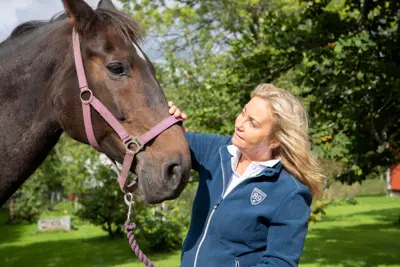
Henrika Jormfeldt.
“We saw that children and young people developed self-confidence, became more present and experienced a greater sense of inner calm”, says Henrika Jormfeldt, Professor of Nursing and Project Leader.
Parents reported a change in reduced school absenteeism, increased harmony in everyday life, decreased anxiety-related symptoms, improved ability to regulate emotions, and better self-esteem and self-confidence.
“We were also able to see how children who had previously struggled to follow instructions and were easily distracted gradually became more present and receptive”, says Henrika Jormfeldt.
A supportive environment that promotes development and hope for the future
The studies show that the environment is crucial in equine-assisted therapy. The calm and non-demanding setting allows children and adolescents to be themselves and reduces stress and anxiety.
Interaction with the horses strengthens self-confidence, trust and the sense of being “good enough”, which also has an impact on everyday life outside the therapy. For many families, the therapy becomes a turning point, where children develop greater independence, improved emotional regulation and increased confidence in their own abilities.
Potential as an important complement in healthcare
The research group argues that the results demonstrate considerable potential for equine-assisted therapy as a complement to traditional treatment. Despite this, the method is still used to a limited extent within healthcare.
One challenge is the lack of knowledge and clear models for implementation. At the same time, the studies indicate that this form of therapy aligns closely with the aims of modern psychiatric care, where the focus is on the whole person rather than solely on symptoms.
Astrid, age 16, has undergone equine-assisted therapy over the past few years. At the age of 12, she was diagnosed with social anxiety disorder by the Child and Adolescent Psychiatry. Her anxiety primarily affected her school attendance. After trying various traditional treatments without improvement, equine-assisted therapy was suggested as an alternative.
“After about a year of equine-assisted therapy, I noticed a clear improvement. I was able to take up more space in the classroom and even order food on my own in restaurants. Today, I no longer find public environments particularly difficult. Equine-assisted therapy has helped me a great deal, and I do not feel the same pressure to talk about my problems as I did in traditional therapy”, says Astrid.
Need for further research
The research group at the University calls for further studies to better understand how this form of therapy can be integrated into healthcare in a structured way.
“Further research is needed to examine whether the results can be confirmed in larger studies and how different professional groups can use equine-assisted interventions in their work. The aim is to be able to offer children and young people with mental health issues more holistic and research-based support that can serve as a complement or alternative to traditional medical treatment”, says Henrika Jormfeldt.
The findings already indicate that equine-assisted therapy can make a difference by creating a safe environment where adolescents are given the opportunity to develop, step by step.
Text: Vilma Olofsson
Photo: AI generated by Halmstad University (top photo), Dan Bergmark
Notes: Equine-assisted therapy should not be confused with traditional equestrian sports, which involve performance demands that may negatively affect both children and horses. Equine-assisted activities provide a non-demanding environment that offers safety and recovery in the relationship between child and horse.
