Undetected visual impairment
“Undetected visual impairment” was a research collaboration where the researchers investigated undetected visual impairment in people over the age of 75, and whether diagnostics and treatment of visual impairment could be optimised by using existing technology in new areas. The project received research funding from the Regional Fund Interreg Öresund-Kattegatt-Skagerack.
Good eyesight is vital for wellbeing, health, and everyday independence. Visual impairment creates significant challenges for people, affecting both their wellbeing and overall health. When eyesight deteriorates, the risk of falling increases. Elderly with reduced vision often remain at home, become isolated, and may need support in their daily lives. This is why it is important to take timely measures.
It is well known that some older people do not seek help for their vision problems. When eyesight declines gradually over a long period, the change often goes unnoticed until the impairment has become severe. This is unfortunate, as in some cases the loss of vision can be corrected with a pair of glasses. Others may have an eye condition for which appropriate treatment can slow further deterioration.
As part of the research and innovation project Undetected visual impairment, a cross-disciplinary and cross-border collaboration took place across the Öresund region to identify people over the age of 75 with impaired vision who do not seek examination or treatment themselves. The aim was to help more people maintain good eyesight – even when they are older.
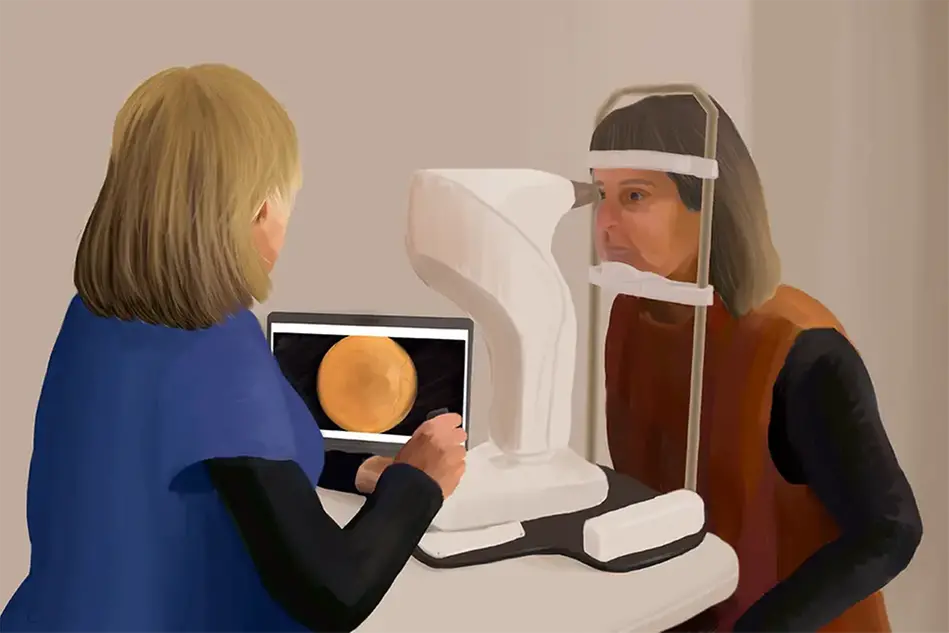
With a fundus camera, you can see changes in the eye fundus. Illustrator: Emma Swahn
The project resulted in four recommendations for the early identification of visual impairment:
- Targeted information on eye health
- Early detection and involvement of specialists
- Straightforward examinations and the use of technology
- Improved collaboration and clearly defined roles
The project concluded at the end of November 2025. More insights and recommendations that emerged from the project are available in the final report in Swedish, found among the links below.
Several research findings will be published only after the project has ended. These will be available on the project’s Danish website, which is also linked below.
About the project
Project period
1 december 2022–30 november 2025
Project managers
- Ditte Hartvig, project leader for the entire project, Sjælland University Hospital
- Jeanette Källstrand, local project leader and Senior Lecturer in Caring Sciences, Halmstad University
Other participating researchers at Halmstad University
- Carina Göransson, Senior Lecturer in Caring Sciences
- Janicke Andersson, Docent in Social Work
- Ilze Lace, Senior Lecturer in Rural Sociology
Collaboration partners
Municipalities, opticians and universities in Skåne and Halland, Sweden, Hovedstaden and Sjælland in Denmark as well as Oslo and Agder in Norway.
Financier
Interreg Öresund-Kattegat-Skagerrak, who supports the project with 1 595 019 Euro