Professor’s portrait: From childhood creativity to sustainable design research
As a child, Lars Eriksson built small inventions at home with his father. Today, he is Professor of Industrial Design at Halmstad University, researching how we experience surfaces and materials, and how design can contribute to both wellbeing and sustainable development.
“Giving young people a good education and the opportunity to follow their dreams is perhaps the most meaningful aspect of being a professor”
Lars Eriksson, Professor of Industrial Design
His interest in creating things arose early. Architecture first captured his attention, and the path led to studies at Umeå University. It was there that Lars Eriksson discovered the field that united artistic expression with technological development: industrial design.
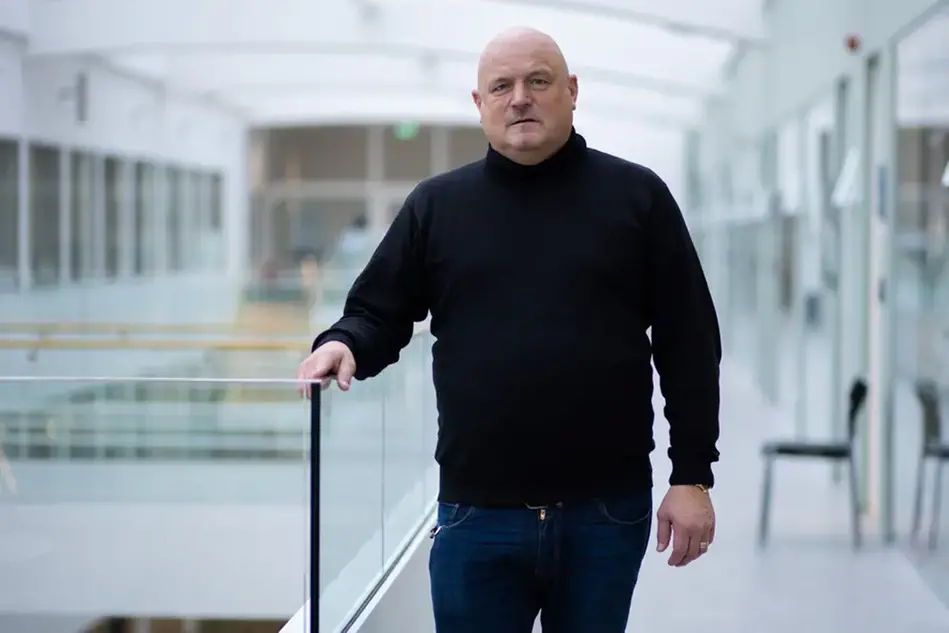
Lars Eriksson, Professor of Industrial Design.
Research on surfaces through the senses
Today, Lars Eriksson leads various research projects on how people experience surfaces and materials.
“We study how people use their senses to perceive surfaces and textures, such as softness, quality and durability. By measuring the experience, we can ensure that a surface expresses what you want and retains its properties throughout the entire production chain”, says Lars Eriksson.
Prostheses adapted to individual needs
One of Lars Eriksson’s projects has focused on prostheses and how they can be adapted to the user’s needs and self-expression. Here, it became clear that design is not only about function, but also about identity and wellbeing.
“We saw that users have different needs and wishes. An elderly person who has been amputated due to illness may have different preferences to a younger person who has been in an accident. By adapting prostheses, users can choose whether to display them more or less prominently, and that is crucial for wellbeing”, says Lars Eriksson.
Design for sustainability
The research also has significant impact on industry’s transition to sustainable materials. By measuring how users experience new surfaces, companies can make material changes with confidence that the product will not be perceived as inferior.
“When you change a surface or a material, it’s crucial that the user still experiences quality. Uncertainty about how it will be received makes many companies hesitant, and that’s where we can contribute important knowledge”, says Lars Eriksson.
Together with Volvo Cars, Lars Eriksson’s research group worked on the project Chrome Surf, which aimed to replace hexavalent chromium – a material long used in the automotive industry but harmful to both the environment and human health. By examining how different user groups experienced the new surface coatings, the researchers were able to show that younger generations had high acceptance of sustainable alternatives, whilst older generations more often preferred classic bright chrome.
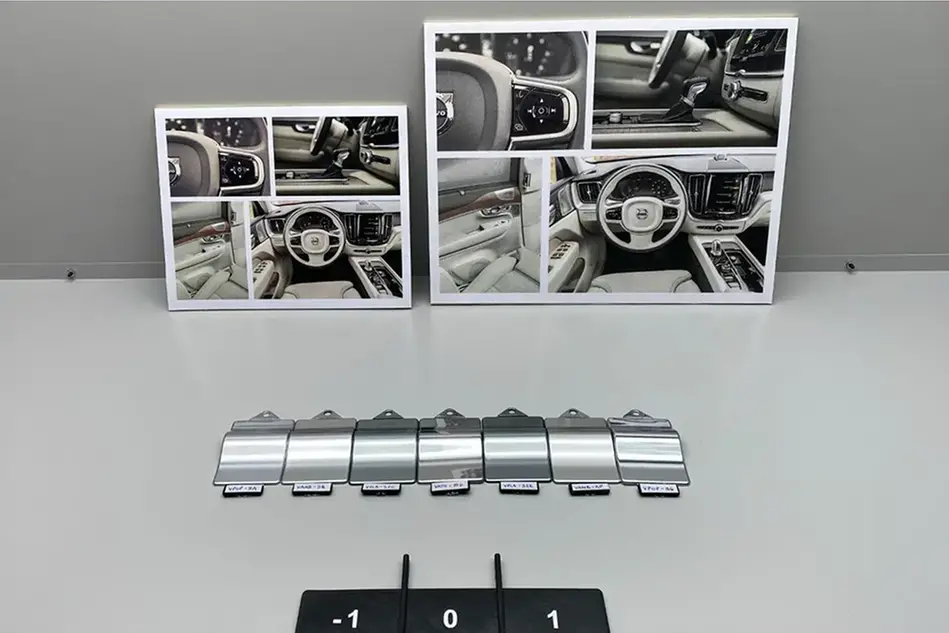
Lars Eriksson conducts research on sustainable surface coatings and has observed that younger users are more inclined to choose them, while older users more often prefer traditional bright chrome. Photo: Linda Karlsson
Similar challenges exist in other industries, for example in the manufacture of heat pumps. In many cases, the entire production process is built around a specific material, making changes difficult to implement. By measuring how users experience new materials, research can support companies in taking the step towards more sustainable solutions.
Societal benefit and education
For Lars Eriksson, research is closely connected to education and societal benefit. He sees it as part of the professor’s role to share knowledge with the next generation and to create conditions for collaboration between different professional groups.
“I have trained more than 200 engineers in design, so that they can work together with product developers and designers. That is important for society. Giving young people a good education and the opportunity to follow their dreams is perhaps the most meaningful aspect of being a professor”, says Lars Eriksson.
Lars Eriksson also describes the professorship as an opportunity to influence society towards sustainability and innovation.
Dare to think differently and take responsibility
Lars Eriksson looks ahead to new projects and collaborations where design can play a crucial role for both people and the environment. For him, it is important that research does not remain theoretical but leads to practical solutions that make a difference in everyday life.
Lars Eriksson emphasises that future challenges require researchers and companies to dare to think in new ways and take responsibility for sustainability. Developing methods that combine technical innovation with human needs is a driving force for him. In this way, he hopes to contribute to a society where design creates not only products, but also value for people and our planet.
Text: Anna-Frida Agardson
Photo: Anna-Frida Agardson
About Lars Eriksson
Lars Eriksson earned his master’s degree in Industrial Design at Umeå Institute of Design in 1994. The same year, he and a fellow student developed a one-wheeled scooter called Monomed, which gained widespread attention.
After graduation, he worked as an industrial designer on commissions for various companies, including the design of measuring instruments and furniture for Grythyttan Stålmöbler. He has also undertaken assignments in design management for several companies. Later, he returned to academia and was responsible for a master’s programme in advanced product design at Umeå Institute of Design, whilst also teaching at other design schools such as Konstfack and Beckmans.
In 2003, Lars Eriksson came to Halmstad University for the first time and created design courses for engineering students. He also co-founded Design Halland, an initiative where companies and students collaborated on various projects. Within this framework, five summer design studios were run – practical summer projects where students and local stakeholders met to develop creative solutions. One of these resulted in five half-hour programmes about design broadcast on SVT in 2005. Lars Eriksson was the presenter for the series, which was awarded joint first prize by Svensk Form for best project.
In 2006, Lars Eriksson was appointed Professor of Industrial Design at the School of Engineering in Jönköping. Shortly after, in 2007, he and colleagues launched a master’s programme in industrial design for engineers. Between 2016 and 2024, he was Visiting Professor and Affiliated Professor at Halmstad University. In 2025, he was appointed Professor at Halmstad University.
