ProActS – Promoting resource efficiency, co-creative Actions, and Innovation for Sustainable transition
The research programme ProActS (Promoting resource efficiency, co-creative Actions, and Innovation for Sustainable transition) takes a broad and multidisciplinary approach to sustainability issues. The goal is to positively contribute to societal developments in sustainability and circularity. The research includes environmental, social and economic sustainability.

ProActS tackles challenges regarding, for an example, energy, water, food and climate change. The programme is part of the University's focus area Smart Cities and Communities. It aims to explore and solve societal problems related to using resources in a circular way.
The research programme brings together researchers in business administration, energy engineering, environmental science, humanities, information technology, innovation sciences and social sciences from all of the University's faculties. The research includes environmental, social and economic sustainability and is carried out in close collaboration with the surrounding society.
Research questions
The programme addresses the following questions:
- How can resource and energy efficiency solutions co-created with relevant stakeholders promote sustainable transition?
- By what governance principles and policies, circular business models, and digital solutions, may sustainable transition be facilitated, supported, and achieved towards smart cities and communities?
- What barriers and drivers exist for a societal transition towards circularity and what solutions could be used to overcome barriers and strengthen drivers?
Four central themes
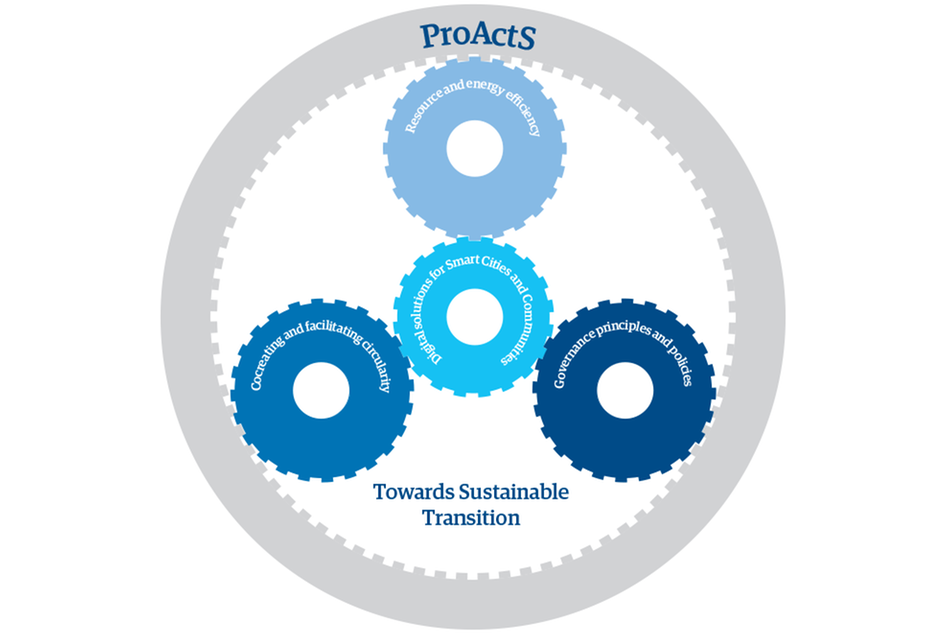
The research programme is centered around four themes.
- Resource and energy efficiecy
- Cocreating and facilitating circularity
- Governance principles and policies
- Digital solutions for smart cities and communities
Participating researchers
School of Business, Innovation and Sustainability
Christa Amnell, Lecturer
Mohammad Saeid Atabaki, Postdoctoral Position
Helge Averfalk, Senior Lecturer
Henrik Barth, Senior Lecturer
Tiedo Behrends, PhD student
Johannes Berglind Söderqvist, Lecturer
Jasmin Borgert, PhD student
Mike Danilovic, Professor
Henrik Gadd, Senior Lecturer
Mei Gong, Senior Lecturer
Fawzi Halila, Professor
Anna Hansson, Senior Lecturer
Jeaneth Johansson, Professor
Niklas Karlsson, Senior Lecturer
Arvid Karsvall, Lecturer
Antonia Liess, Professor
Johan Lind, Lecturer
John Lindgren, Senior Lecturer
Alina Linden, PhD student
Ludvig Lindlöf, Senior Lecturer
Marie Mattsson, Professor
Martin Melin, Senior Lecturer
Erik Möllerström, Senior Lecturer
Lucia Naldi, Professor
Henrietta Nilson, Senior Lecturer
Heidi Norrström, Senior Lecturer
Cintia Oliveira Carvalho, Postdoctoral Position
Senad Osmanovic, PhD student
Fredric Ottermo, Docent
Urban Persson, Professor
Sara Pourmorshed, PhD student
Fazle Rahi, Senior Lecturer
Olga Rauhut Kompaniets, Senior Lecturer
Sabina Rebeggiani, Senior Lecturer
Luis Sánchez Garcia, PhD student
Per Servais, Visiting Professor
Johanna Sjöstedt, Docent
Mohsen Soleimani Mohseni, Senior Lecturer
Per-Ola Ulvenblad, Senior Lecturer
Pia Ulvenblad, Docent
Sven Werner, Senior Professor
Adel Younis, Senior Lecturer
Ghazal Zalkat, Postdoctoral Position
Robert Ågren, Lecturer
School of Education, Humanities and Social Sciences
Emilia Aldrin, Docent
Danielle Cudmore, Senior Lecturer
Linnea Gustafsson, Professor
School of Information Technology
Oscar Amador Molina, Associate Senior Lecturer
School of Health and Welfare
Research projects
-
More biogas is needed on both sides of the Øresund for the green transition and to reduce greenhouse gas emissions. To achieve this, agriculture must contribute with more biomass. Through the project,
-
The project aims at building a permanent network of scholarly reflection, joint research, exchange of methodologies, and advocacy to strengthening regional integration and cooperation in and between
-
The DHC Academy is designed to address the growing need for skilled professionals in the European heating and cooling sector, which is critical for achieving decarbonisation goals and energy
-
Business support organizations, in collaboration with SMEs operating within Halland's areas of smart specialization—Sustainable Materials and Sustainable Food—and academia, aim to develop and test a
-
Future district heating systems face challenges that can partly be met with lower heat distribution temperatures. In two stages since 2016, Halmstad University has run an innovation project to develop
-
WISE is an Erasmus+ project (Action Type KA220-ADU – Cooperation Partnerships in Adult Education) that aims to enhance financial literacy and economic empowerment among migrant women by equipping both
-
Getting Out of Comfort Zone (GOOCZ) – an Erasmus+ Cooperation Partnership in Higher Education – addresses the need to bridge the gap between academia and industry through transnational,
-
INCH establishes a regional innovation arena at Halmstad University to strengthen innovation capacity in civil defence, preparedness, and sustainable industrial transformation in Halland, Sweden. The
-
Agricultural intensification in EU farmland led to the loss of landscape features which provide ecosystem services and support for biodiversity. To tackle this, the EU Biodiversity Strategy for 2030
-
Today, there are divided opinions about whether solar cells on agricultural land exclude the possibility of growing crops on the same land. But there are solutions where agriculture and solar energy
-
The project aims to increase the use of research results by lowering the thresholds for technology transfer between universities, industry and business supporting actors in Halland. The project
-
To achieve the goal of a carbon-neutral Europe by 2050, the district heating sector faces significant challenges over the next three decades. This is especially true for system owners and operators,
-
Symbios in Halland is a project initiative that aims to strengthen the region's ability to develop industrial symbiosis – a smart and sustainable way of collaborating where one actor's waste product
-
The project combines multiple perspectives to create a toolkit for circular and eco-efficient production. The project directly aims to support manufacturing companies in their sustainability journey.
-
The nZEBRA project aims to develop an intensive blended learning course in the form of a summer school, on climate neutral buildings, to meet new requirements for complex conditions and nearly zero
News within ProActS
Contact
-
Professor and Research Programme Leader
-
Professor and Deputy Research Programme Leader
