
FIRP – Future Industry Research Programme
The Future Industry Research Programme (FIRP) focuses on societal challenges such as resilience, global competitiveness, innovation and economic growth through collaboration and co-creation with industry. Through responsible innovation, the research programme aims to support technological progress for the benefit of society as a whole.
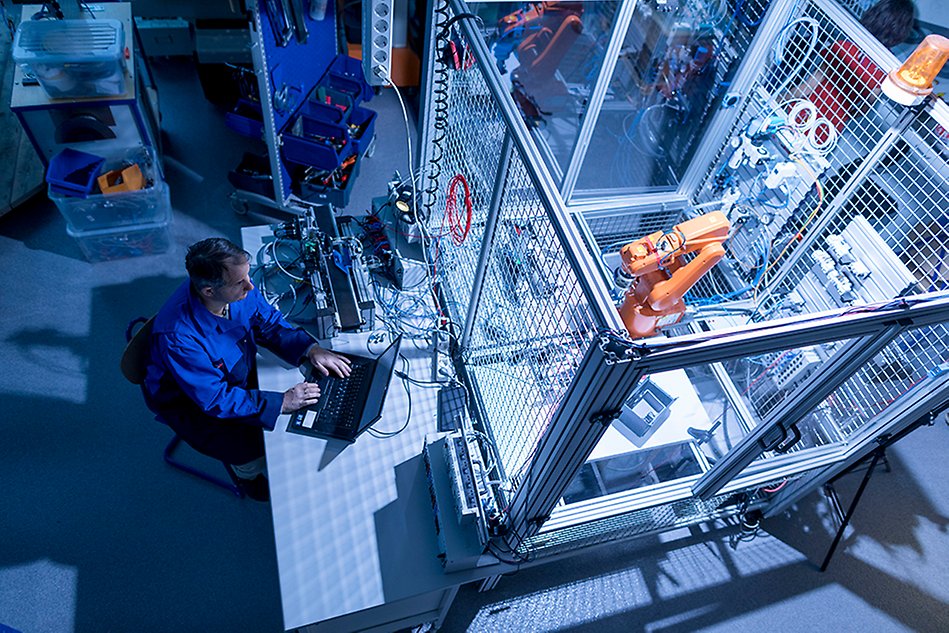
Ensuring continuous and responsible innovation while remaining sustainable and competitive is a major challenge for the industry today, which can only be solved through multidisciplinary collaboration between many different stakeholders.The research programme wants to contribute to meeting this major challenge.
FIRP is part of the University’s focus area Smart Cities and Communities and is in line with Industry 4.0 and Industry 5.0. This means that the research aims for increased digitisation of industry, while at the same time being socially responsible, sustainable and overall beneficial to society.
FIRP works with five of the Sustainable Development Goals: Industry, Innovation and Infrastructure; Decent Work and Economic Growth; Sustainable Cities and Communities; Gender Equality; Quality Education; and Responsible Consumption and Production.
The vision of FIRP is to promote research excellence, strengthen university-industry-society cooperation and integrate more research into education to prepare people and industry for future challenges and opportunities. The programme aims to position Halmstad University as a leader in interdisciplinary technological research and help meet modern societal and industrial needs.
Three key themes and clusters
The research programme consists of three collaborative clusters to solve complex industrial challenges. The clusters bring together researchers from disciplines such as artificial intelligence, machine learning, materials and sensors, surface metrology, cybersecurity, additive manufacturing, computer vision, autonomous systems and predictive maintenance
Innovative industry
Innovative industry is primarily involved in researching and applying cutting-edge technologies and processes across a range of strong areas at the University: semiconductor technology, nanoscience, digital radar systems, sensor systems for autonomous vehicles, functional surfaces and advanced manufacturing techniques.
Resilient industry
Resilient industry works with the capacity of industrial sectors to maintain security, reliability, and sustainability amidst the challenges posed by an increasingly digital and interconnected world. This encompasses a broad range of concerns, including cyber security, data privacy and authenticity, resilience to hardware or software failures, and protection against external threats
Predictive industry
Predictive industry revolves around creating systems capable of autonomous knowledge construction from real-life data generated through interactions between an industrial system and its environment. A central application within Predictive Industry is predictive maintenance (PdM), which aligns with the objective of achieving cost and efficiency gains for industries. This application is tightly connected to the use of HU’s strengths in Artificial Intelligence (AI) and Machine Learning (ML).

Image: AI generated by Ross Friel
Research questions
- How can advanced data analytics and machine learning improve industrial processes?
- What methods and technologies can improve the robustness and security of industrial systems against cyber and physical disruptions?
- How can innovative sensor technologies, materials and surfaces improve industrial capabilities?
- How can predictive models be developed to anticipate equipment failures and optimise operations?
Participating researchers
School of Information Technology
- Abu Mohammed Raisuddin, PhD student
- Anna Vettoruzzo, PhD student
- Canberk Özen, PhD student
- Carlos Nascimento Silla Junio, Professor
- Cristofer Englund, Professor
- Edison Pignaton De Freitas, Professor
- Elena Haller, Senior Lecturer
- Emil Nilsson, Senior Lecturer
- Eren Erdal Aksoy, Senior Lecturer
- Fernando Alonso-Fernandez, Professor
- Grzegorz Nalepa, Professor
- Håkan Pettersson, Professor
- Hamid Sarmadi, Associate Senior Lecturer
- Hans Hellsten, Adjunct Professor
- Idriss Gouigah, doktorand
- Jeong Min Kang, Post Doc
- Jesper Holmblad, Research Engineer
- Joel Nyholm, PhD student
- Josef Bigun, Professor
- Kevin Hernandez Diaz, Post Doc
- Kunru Chen, Post Doc
- Mahdi Fazeli, Senior Lecturer
- Mark Dougherty, Professor
- Marlena Nowaczyk, Senior Lecturer
- Martin Cooney, Senior Lecturer
- Mohamed Eldefrawy, Senior Lecturer
- Mumpy Das, Research Engineer
- Oscar Molina, Associate Senior Lecturer
- Parisa Jamshidi, PhD student
- Per Sandrup, Research Engineer
- Peyman Mashhadi, Senior Lecturer
- Prayag Tiwari, Senior Lecturer
- Sepideh Pashami, Senior Lecturer
- Slawomir Nowaczyk, Professor
- Sundas Munir, Lecturer
- Wojciech Mostowski, Senior Lecturer
- Yuantao Fan, Associate Senior Lecturer
- Zahra Taghiyarrenani, Post Doc
- Zeinab Shahbazi, Post Doc
School of business, innovation and sustainability
Research projects
-
The primary aim of the project is to explore AI’s role in cybersecurity, address emerging risks, and develop training materials while fostering synergy and capacity building. AI is transforming the
-
The project is about automatic analysis of indoor crime scenes. We will study AI technologies for environment mapping, segmentation and classification of objects and traces found at such scenarios
-
Global supply chains in the automotive aftermarket are increasingly complex, driven by intermittent demand, regional market variations, and sudden spikes in customer requirements. Traditional
-
Digital images, ubiquitous in Swedish society and industry, represent a sophisticated and evolving vector for cyberattacks. Threats include stealthy zero-click exploits and AI-assisted steganography,
-
The FREEWAY project aims to deliver next-generation digital services for electromobility by enabling asynchronous federated learning (AFL) to address scalability challenges, especially for large
-
The KEEPER research project will develop novel Artificial Intelligence (AI) and Machine Learning (ML) methods for creating knowledge from raw, largely unlabelled industrial data to enhance the
-
LEAD-AI is an Erasmus+ project that aims to strengthen AI literacy and digital competences in adult education. The project responds to the rapid expansion of generative Artificial Intelligence and its
-
This joint project between RISE, ClimaCheck and Halmstad University is Sweden’s contribution to the IEA HPT Annex on Digital Services for Heat Pumps. The aim is to develop advanced methods for
-
Complex environment and traffic conditions have a major impact on the safety and operations of Connected and Automated Vehicles (CAVs). Weather affects not only the vehicle performance but also the
-
Refractor is a three-year collaborative project that aims to strengthen small and medium-sized enterprises (SMEs) in the electronics sector through knowledge, networks and resources. The project runs
-
SMILE IV focuses on optimising and implementing the safety architecture and safety components for two distinct use cases of small autonomous vehicles: transport robots in factory settings and delivery
News within FIRP
Contact
-
Research Programme Leader
-
Deputy Research Programme Leader
