
Research within Smart Cities and Communities
The research linked to the focus area takes an interdisciplinary approach to societal challenges linked to smart cities and communities. A majority of the research takes place within the framework of five research programmes.
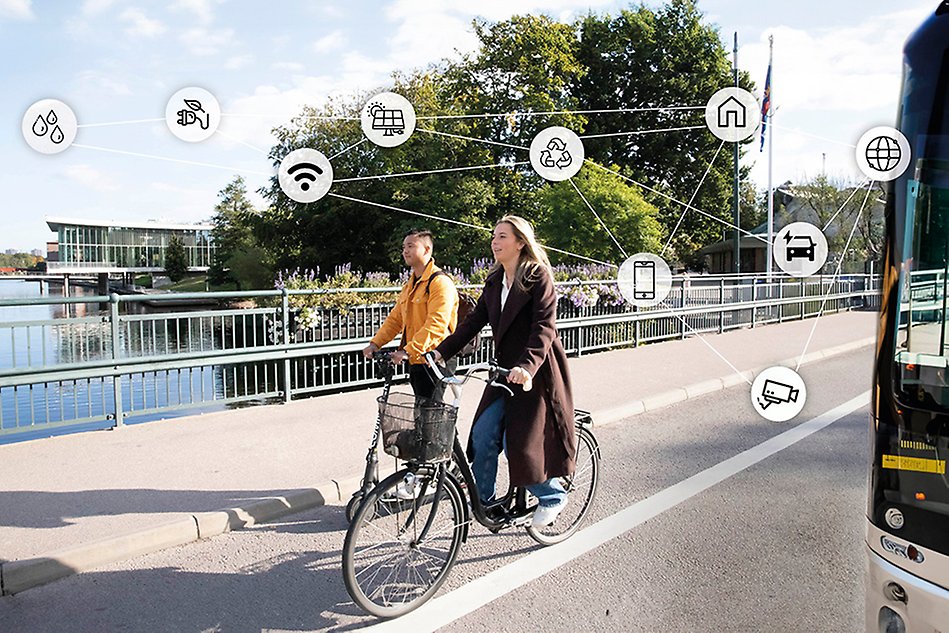
The purpose of the research programmes is to develop the University’s research. They are clearly linked to the focus area and contribute to knowledge building within all six dimensions of the focus area. The research is multifaceted and conducted by researchers in several fields.
Research programmes which are part of focus area Smart Cities and Communities
- FIRP – Future Industry Research Programme
- LeaDS – Learning in a Digitalised Society
- ProActS – Promoting resource efficiency, co-creative Actions, and Innovation for Sustainable transition
- REBEL – Re-Imagining Future Smart Living – Beyond the Living Lab
- TRAINS – Transformation, Innovation and Norm Sciences
Elevator pitches about research
Watch films, about research in smart cities and communities, on Youtube. In each episode, a researcher is given the task of explaining his or her research in the time it takes to go up to the Trade Centre, a 22-storey building, at Halmstad University – a real elevator pitch.
45 seconds on how children and young people choose to travel External link.
45 seconds about online shopping's final journey to the consumer External link.
45 seconds about sustainable commuting External link.
45 seconds about how social media has changed destination marketing External link.
45 seconds about disinformation and critical thinking External link.
45 seconds on sustainable mobility on Sweden's west coast External link.
45 seconds on wage development for low-wage jobs External link.
Research projects within focus area Smart cities and communities
-
The primary aim of the project is to explore AI’s role in cybersecurity, address emerging risks, and develop training materials while fostering synergy and capacity building. AI is transforming the
-
The project is about automatic analysis of indoor crime scenes. We will study AI technologies for environment mapping, segmentation and classification of objects and traces found at such scenarios
-
Global supply chains in the automotive aftermarket are increasingly complex, driven by intermittent demand, regional market variations, and sudden spikes in customer requirements. Traditional
-
This project aims to explore academic climate activism and its influence on research. Academic activism, understood as researchers engaged in social movements, has raised concerns in recent debates
-
More biogas is needed on both sides of the Øresund for the green transition and to reduce greenhouse gas emissions. To achieve this, agriculture must contribute with more biomass. Through the project,
-
Can drone technology provide a simple and effective way to achieve cleaner lakes, waterways and seas? Aquality (formerly CatFish) is a water drone that is used to collect samples from bodies of water
-
B-SHAPES focuses on the role of borders shaping perceptions of European societies in the 21st century, confronted with the challenge of re-borderings in Europe. Borders continue to play a key role in
-
The project investigates how undergraduate students’ background and ambitions influence their choice of educational programmes. The project also looks at their thoughts and attitudes during their
-
The project aims to increase understanding of how competing claims on biomass and biogenic hydrocarbons can be managed in the transition to a fossil-free society, focusing on the interaction between
-
The project aims at building a permanent network of scholarly reflection, joint research, exchange of methodologies, and advocacy to strengthening regional integration and cooperation in and between
-
We aim to empower young people with crowd-thinking competences and AI-enhanced skills, fostering their ability to tackle complex societal challenges. We seek to lay the foundation for a European
-
The DHC Academy is designed to address the growing need for skilled professionals in the European heating and cooling sector, which is critical for achieving decarbonisation goals and energy
-
ENSURE aims to develop a better understanding of how research quality and societal impact of energy systems research can be described and assessed, with a particular focus on its contribution to
-
Business support organizations, in collaboration with SMEs operating within Halland's areas of smart specialization—Sustainable Materials and Sustainable Food—and academia, aim to develop and test a
-
Future district heating systems face challenges that can partly be met with lower heat distribution temperatures. In two stages since 2016, Halmstad University has run an innovation project to develop
-
Efficient management of fish stock relies on biological monitoring for obtaining precise data on structure and size of populations. Fishery management commonly lacks knowledge on genetic population
-
Digital images, ubiquitous in Swedish society and industry, represent a sophisticated and evolving vector for cyberattacks. Threats include stealthy zero-click exploits and AI-assisted steganography,
-
The FREEWAY project aims to deliver next-generation digital services for electromobility by enabling asynchronous federated learning (AFL) to address scalability challenges, especially for large
-
WISE is an Erasmus+ project (Action Type KA220-ADU – Cooperation Partnerships in Adult Education) that aims to enhance financial literacy and economic empowerment among migrant women by equipping both
-
Getting Out of Comfort Zone (GOOCZ) – an Erasmus+ Cooperation Partnership in Higher Education – addresses the need to bridge the gap between academia and industry through transnational,
-
GreenLog accelerates systemic changes in last mile delivery ecosystems for economically, environmentally and socially sustainable city logistics. The project establishes city platforms comprising of
-
The PhD project focuses on the integration of Generative AI, specifically Large Language Models (LLMs) like ChatGPT, in upper secondary school STEM education. The project aims to explore the
-
The transport sector has great potential in the green transition. The municipalities have a major role in boosting the green conversion of transport, because they have several strings to play. The
-
The research group Sustainable Exercise and Rehabilitation (SER) within Movement for Health and Performance (M4HP) conducts research on the effects of physical activity on the body's tissues and
-
INCH establishes a regional innovation arena at Halmstad University to strengthen innovation capacity in civil defence, preparedness, and sustainable industrial transformation in Halland, Sweden. The
-
The INTERCAMBIO project sets out to promote the mental and physical health of workers navigating changing environments with a particular focus on green jobs. The anticipated impact of the project
-
The KEEPER research project will develop novel Artificial Intelligence (AI) and Machine Learning (ML) methods for creating knowledge from raw, largely unlabelled industrial data to enhance the
-
Agricultural intensification in EU farmland led to the loss of landscape features which provide ecosystem services and support for biodiversity. To tackle this, the EU Biodiversity Strategy for 2030
-
LEAD-AI is an Erasmus+ project that aims to strengthen AI literacy and digital competences in adult education. The project responds to the rapid expansion of generative Artificial Intelligence and its
-
The project’s goal is to strengthen the innovation capacity of life science startups in the ØKS area, by ensuring that products capable of being marketed are completed in the long term creates
-
How are representations of cultural diversity developed and handled in interplay with societal changes? Discourses surrounding children can have an impact on segregation and support the formation of
-
This joint project between RISE, ClimaCheck and Halmstad University is Sweden’s contribution to the IEA HPT Annex on Digital Services for Heat Pumps. The aim is to develop advanced methods for
-
This postdoctoral project, funded by Forte, explores how split shifts affect assistant nurses working in elderly care. Split shifts – where the working day is divided into two separate parts with a
-
Complex environment and traffic conditions have a major impact on the safety and operations of Connected and Automated Vehicles (CAVs). Weather affects not only the vehicle performance but also the
-
Refractor is a three-year collaborative project that aims to strengthen small and medium-sized enterprises (SMEs) in the electronics sector through knowledge, networks and resources. The project runs
-
SMILE IV focuses on optimising and implementing the safety architecture and safety components for two distinct use cases of small autonomous vehicles: transport robots in factory settings and delivery
-
SPINE’s vision is to accelerate the progress towards climate neutrality by reinforcing public transport (PT) systems through their smart integration with new mobility services, sharing schemes, active
-
Today, there are divided opinions about whether solar cells on agricultural land exclude the possibility of growing crops on the same land. But there are solutions where agriculture and solar energy
-
The project aims to increase the use of research results by lowering the thresholds for technology transfer between universities, industry and business supporting actors in Halland. The project
-
This project will study the role of women’s and children’s labour in the early stages of Swedish industrialisation. While the work of gender historians shows a large participation of women and
-
The Strategic Leadership in Green Businesses programme supports the transition to sustainable production models in Latin America, aligning with the European Green Deal. It equips students and
-
To achieve the goal of a carbon-neutral Europe by 2050, the district heating sector faces significant challenges over the next three decades. This is especially true for system owners and operators,
-
Symbios in Halland is a project initiative that aims to strengthen the region's ability to develop industrial symbiosis – a smart and sustainable way of collaborating where one actor's waste product
-
The project aims to develop knowledge about how regional collaboration contributes to building the multifaceted capacity required to create fossil-free welfare states. VERSAM explores the complex
-
The project combines multiple perspectives to create a toolkit for circular and eco-efficient production. The project directly aims to support manufacturing companies in their sustainability journey.
-
The PhD project “Virtual cases for developing professional competence regarding domestic violence” focuses on how interactive computer-based simulations can contribute to the professional competence
-
When humans interact with technology, they are often perceived as the weakness of the systems. The expression ”the human factor” emphasises human’s inability to function flawlessly, in relation to
-
Young People in Rural Halland is a microproject focusing on the living conditions of young people in rural Halland. The project is funded by Lokalt Ledd Utveckling Halland and addresses social
-
The nZEBRA project aims to develop an intensive blended learning course in the form of a summer school, on climate neutral buildings, to meet new requirements for complex conditions and nearly zero
